
How Can I Speak English Fluently in 90 Days? A Practical Guide for Beginners
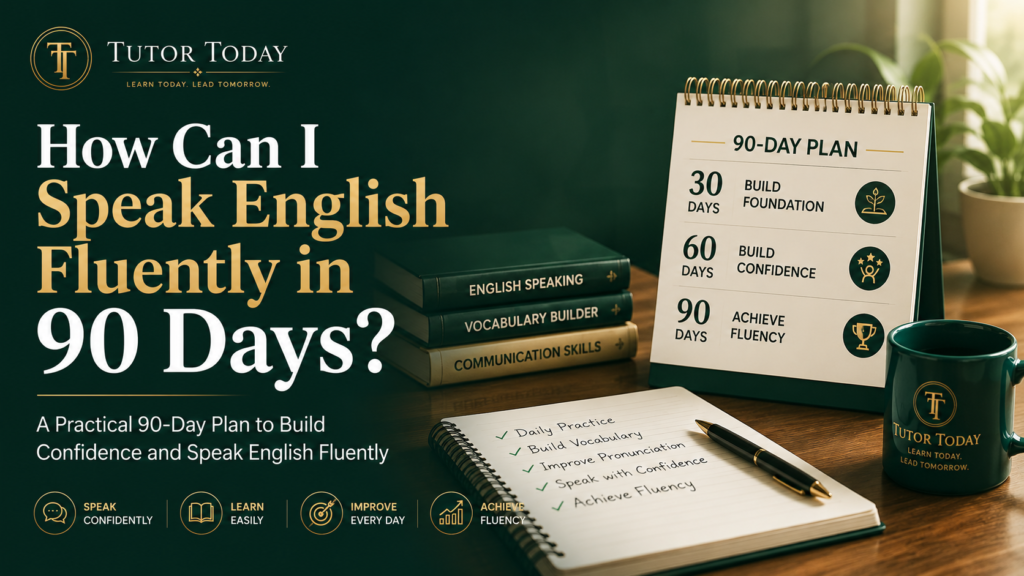
Table of Contents
Learning to speak English fluently is a common goal for students, beginners, job seekers, and working professionals. But many learners struggle with the same questions: How can I speak English fluently in 90 days? How can I improve my speaking skills? And how can I become more confident while speaking English?
The good news is that you can make significant progress in 90 days with a consistent learning routine. You do not need to memorise thousands of words or study complicated grammar rules for hours. Instead, focus on daily speaking practice, listening, vocabulary, pronunciation, sentence formation, and confidence.
This guide explains a practical 90-day strategy to help you improve your English speaking skills step by step.
How Can I Speak English Fluently in 90 Days?
If you are wondering how can I speak English fluently in 90 days, start by dividing your learning into three stages.
Days 1–30: Build Your Foundation
During the first 30 days, focus on basic English vocabulary, sentence formation, pronunciation, and everyday communication.
Practise talking about familiar topics such as:
- Your introduction
- Your family
- Your daily routine
- Your school or college
- Your job
- Your hobbies
- Your favourite food
- Your future plans
- Your weekend activities
Start with simple sentences instead of trying to use complicated English.
For example:
I wake up at 7 AM every day.
I usually have breakfast before going to school.
I enjoy reading books in my free time.
The objective is to become comfortable speaking English aloud.
Days 31–60: Develop Your Speaking Skills
During the second month, increase your speaking practice.
Start discussing topics such as education, technology, social media, travel, career goals, hobbies, and your opinions.
Try speaking for five to ten minutes without reading from a prepared script.
Days 61–90: Practise Real Conversations
During the final month, focus on spontaneous communication.
Practise:
- Job interviews
- Classroom discussions
- Presentations
- Meetings
- Introducing yourself
- Asking questions
- Giving opinions
- Group discussions
- Everyday conversations
Your goal should be to respond naturally instead of translating every sentence from your native language.
How to Speak English Fluently at Home
If you want to learn how to speak English fluently at home, create an English-speaking environment around yourself.
You can practise English without travelling abroad or spending several hours in a classroom.
Speak to Yourself in English
Describe your daily activities in English.
For example:
I am getting ready for work.
I am making breakfast.
I need to finish this assignment.
I am going to the market.
This simple habit helps you start thinking in English.
Read English Aloud
Choose a short article, story, educational text, or news report and read it aloud for 5–10 minutes.
Reading aloud helps you practise:
- Pronunciation
- Vocabulary
- Sentence structure
- Speaking speed
- Confidence
Record Yourself Speaking
Choose a simple topic and record yourself speaking for two or three minutes.
You can talk about:
- My favourite hobby
- My daily routine
- My career goals
- My family
- Why I want to learn English
Listen to your recording and identify areas where you hesitate or make repeated mistakes.
Then record yourself again.
How to Improve English Speaking Skills at Home
If you want to know how to improve English speaking skills at home, focus on active practice rather than only watching English videos or reading grammar books.
A useful method is:
Listen → Repeat → Speak → Review
Listen
Listen to a short English conversation, podcast, lesson, or video.
Pay attention to pronunciation, vocabulary, sentence structure, and natural pauses.
Repeat
Pause the audio and repeat each sentence.
Try to copy the speaker’s rhythm and pronunciation.
Speak
Now explain the same topic using your own words.
Do not try to memorise the original sentences.
Review
Record yourself and listen to the recording.
Identify two or three areas that you can improve.
This process turns passive English learning into active speaking practice.
How to Speak English Confidently for Beginners
For people learning English for the first time, confidence can be just as important as grammar.
If you want to know how to speak English confidently for beginners, start by accepting that mistakes are part of learning.
You do not need perfect English before you start speaking.
For example, a learner might say:
Yesterday I go to the market.
The correct sentence is:
Yesterday I went to the market.
Instead of becoming embarrassed by the mistake, learn the correction and continue speaking.
Start With Simple English
Do not try to use complicated vocabulary just to sound advanced.
Simple and clear English is often more effective.
Instead of:
I am experiencing considerable exhaustion due to my extensive workload.
You can say:
I am very tired because I have a lot of work.
The second sentence is simple, natural, and easy to understand.
Learn Useful Conversation Phrases
Beginners can learn phrases such as:
- How are you doing?
- What do you do?
- Where are you from?
- What do you like to do?
- What do you think?
- Could you explain that?
- Can you say that again?
- I agree with you.
- I am not sure about that.
- In my opinion…
These phrases provide a useful foundation for everyday conversations.
How to Improve English Fluency Quickly
If you are searching for how to improve English fluency quickly, focus on consistent practice instead of trying to learn everything at once.
A simple daily routine can include:
Activity | Time |
Listening | 10 minutes |
Vocabulary | 5 minutes |
Reading aloud | 5 minutes |
Speaking | 10 minutes |
Review | 5 minutes |
This takes only around 35 minutes a day.
The key is consistency.
Practising for 30–40 minutes every day can be more useful than studying for several hours only once a week.
How to Build English Vocabulary for Better Speaking
Vocabulary is an important part of English communication, but you do not need to memorise long lists of difficult words.
Instead, learn words together with phrases and sentences.
For example:
Word: Improve
Phrase: Improve my communication skills
Sentence: I want to improve my communication skills.
Another example:
Word: Confident
Phrase: Feel confident
Sentence: I want to feel confident while speaking English.
Learning vocabulary in context makes it easier to remember and use during conversations.
How to Stop Translating English in Your Head
One of the biggest problems for English learners is mentally translating every sentence.
When you first create a sentence in your native language and then translate it into English, speaking becomes slower.
Instead, start thinking in simple English.
When you see rain outside, think:
It is raining.
When you feel hungry:
I am hungry.
When you need to leave:
I need to go now.
These small habits can gradually help your brain process English more naturally.
How to Improve English Pronunciation and Speaking Clarity
Fluency is not simply about speaking quickly.
Your pronunciation should be clear enough for other people to understand you easily.
Practise difficult words by:
- Listening to the pronunciation.
- Repeating the word slowly.
- Using the word in a sentence.
- Recording yourself.
- Repeating it again.
You can also practise shadowing.
Listen to a short sentence and immediately repeat it while trying to follow the speaker’s pronunciation, rhythm, and pauses.
What Should I Practise During a 90-Day English Challenge?
A 90-day challenge becomes easier when you have a clear weekly goal.
Month 1: Basic English Speaking
Focus on:
- Daily vocabulary
- Basic sentences
- Self-introduction
- Daily routine
- Reading aloud
- Simple conversations
Month 2: Conversational English
Focus on:
- Longer conversations
- Opinions
- Storytelling
- Describing situations
- Asking questions
- Answering questions
- Speaking without scripts
Month 3: Confident Communication
Focus on:
- Presentations
- Interviews
- Group discussions
- Workplace conversations
- Public speaking
- Spontaneous conversations
At the end of each week, record yourself speaking about the same topic and compare your recordings.
What Are the Common Mistakes That Stop English Fluency?
Many learners spend months studying English without seeing enough improvement because they make some common mistakes.
Studying Only Grammar
Grammar is important, but grammar knowledge alone does not create speaking fluency.
Combine grammar learning with regular speaking practice.
Memorising Difficult Words
Learn vocabulary that you can actually use in everyday communication.
Being Afraid of Mistakes
Mistakes are a natural part of language learning.
Practising Only Once a Week
Regular practice is essential.
Even 15–20 minutes every day can help you develop a consistent habit.
Only Watching English Videos
Watching English content can improve listening, but you also need to speak.
After watching a video, explain what you learned in your own words.
How Can Tutor Today Help You Improve English Communication?
Improving English independently is possible, but structured guidance can make the process more organised and consistent.
Tutor Today helps learners develop stronger communication and learning skills through structured educational support.
For students and beginners, guided English learning can provide opportunities to practise vocabulary, sentence formation, pronunciation, speaking, and communication in a structured environment.
With regular practice and the right guidance, learners can become more comfortable expressing themselves in English.
Start Your 90-Day English Speaking Journey Today
If you have been asking how can I speak English fluently in 90 days, start with a simple daily routine.
Speak English every day.
Listen to English.
Read aloud.
Learn useful phrases.
Record yourself.
Practise conversations.
Correct your mistakes.
Then repeat the process tomorrow.
You do not need perfect English to start speaking. Your first goal should be clear, confident, and consistent communication.
With 90 days of focused practice, you can build a stronger foundation and take an important step toward becoming a more confident English speaker.
Improve spoken English
READ MORE :
- How to Improve Spoken English
- English coaching in Noida
- English speaking classes near me online
- daily English speaking practice
- best online English speaking course in India
- online English speaking course
- Benefits Of Offline tuition
- How to Find you find the best online tutor
- Tutoring Services Near Me
- offline coaching classes in Noida
- Best Tutor Near Me
- tuition class near me
- online and offline tuition
- Best Offline Tuition Classes in Delhi
- Tuition Classes in Noida Sector 26
- Best CBSE Tuition in Noida
Facebook
X
LinkedIn
Pinterest
Tumblr
Pinterest
Tutor Today Blogs