
How to Prepare for CBSE Exams Without Stress
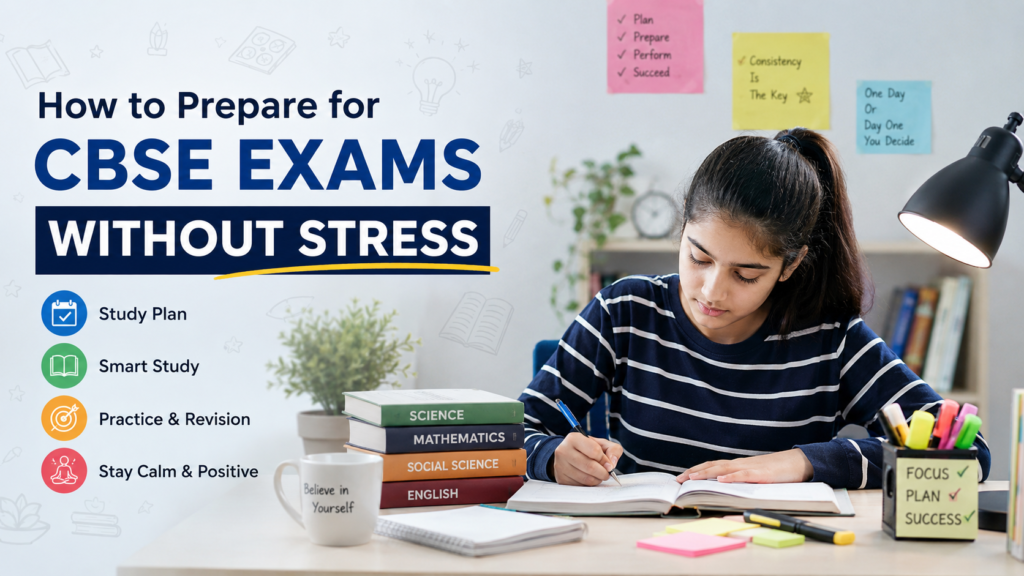
Table of Contents
CBSE exams can be an important milestone in a student’s academic journey. With a large syllabus, multiple subjects, regular assignments, and the pressure to perform well, students can easily feel overwhelmed. However, exam preparation does not have to be stressful.
The key is to start early, create a realistic study routine, understand the syllabus, and revise consistently. When students know what to study and how to manage their time, they can prepare more confidently and avoid last-minute pressure.
In this guide, we will explore how to prepare for CBSE exams without stress, along with practical strategies for board exam preparation, effective studying, revision, and exam-day confidence.
How to Prepare for CBSE Board Exams
Knowing how to prepare for CBSE board exams starts with understanding the syllabus and creating a structured study plan. Instead of trying to study everything at once, divide the syllabus into smaller, manageable sections.
Understand the CBSE Syllabus
Before beginning your preparation, review the syllabus for every subject. Make a list of all chapters and divide them into three categories:
- Topics you already understand
- Topics that need more practice
- Difficult topics that require additional attention
This gives you a clear picture of your preparation and helps you prioritize your time.
Follow NCERT Textbooks
NCERT textbooks should be an important part of CBSE exam preparation. Read each chapter carefully and understand the concepts, examples, exercises, formulas, and definitions.
For Mathematics and Science, practice the questions provided in the textbooks. For subjects such as Social Science and languages, focus on understanding the material and practicing structured answers.
Avoid using too many reference books at once. More study material does not necessarily mean better preparation.
Create a Realistic Study Schedule
A study timetable can help you stay organized and avoid last-minute preparation.
Divide your day into focused study sessions and allocate enough time for every subject. Give additional time to subjects or topics that you find difficult.
Your schedule can include:
- Concept learning
- Question practice
- Revision
- Mock tests
- Doubt-solving
- Short breaks
- Adequate sleep
The most important thing is to create a timetable that you can actually follow.
How to Study for CBSE Exams Effectively
Understanding how to study for CBSE exams effectively is more important than simply studying for long hours.
Effective studying means understanding concepts, actively recalling information, practicing questions, and regularly reviewing your progress.
Focus on Understanding Concepts
Avoid depending entirely on memorization.
Try to understand the reason behind a concept and how it can be applied. This is particularly important for Mathematics and Science, where students need to apply concepts to solve different types of questions.
For theory-based subjects, focus on understanding important points and learning how to present answers clearly.
Use Active Recall
After completing a topic, close your book and try to explain what you learned without looking at your notes.
Ask yourself:
- What are the main concepts?
- Can I explain the topic in my own words?
- Which formulas or definitions do I remember?
- Can I answer questions without looking at the textbook?
Active recall can help you identify topics that require more revision.
Practice Writing Answers
Reading an answer is different from writing it in an examination.
Practice writing answers within a specific time limit. Focus on presenting information clearly and logically.
Pay attention to:
- Answer structure
- Important keywords
- Relevant examples
- Diagrams where required
- Formulas and calculations
- Time management
Regular writing practice can improve both speed and confidence.
Solve Sample and Previous Year Papers
Practice papers are an important part of CBSE preparation.
They help you understand question patterns, practice time management, and identify areas where you need more work.
After completing a paper, review every mistake. Don’t focus only on your final score.
Ask yourself why you lost marks and what you can do differently next time.
Best Way to Prepare for CBSE Exams
There is no single study method that works for every student. However, the best way to prepare for CBSE exams is to follow a consistent preparation cycle:
Learn → Practice → Revise → Test → Improve
Learn
Understand each chapter and build a strong foundation before moving to the next topic.
Practice
Solve textbook exercises, sample papers, previous year questions, and other relevant practice questions.
Revise
Review topics regularly instead of waiting until the last few days before the exam.
Test
Take mock tests under examination-like conditions. Try completing the paper within the required time.
Improve
Analyze your mistakes and spend additional time on topics where you are struggling.
This approach makes preparation more systematic and helps students identify problems before the actual examination.
How to Manage CBSE Exam Stress
Exam stress often comes from feeling unprepared or having too much to complete in a short period.
The best way to reduce this pressure is to break large goals into smaller tasks.
Instead of thinking:
“I have to finish my entire syllabus.”
Set a smaller goal:
“Today, I will complete one chapter and solve 20 practice questions.”
Small, achievable targets make preparation feel more manageable.
Take Regular Breaks
Studying continuously for several hours can lead to mental fatigue. Take short breaks between focused study sessions.
Use your breaks to walk, stretch, drink water, or relax for a few minutes.
Avoid Comparing Yourself With Others
Every student has a different learning style and pace.
Comparing your study hours or marks with classmates can create unnecessary pressure. Focus on your own progress and identify the areas where you can improve.
Maintain a Healthy Sleep Routine
Sleep is an important part of effective preparation.
Staying awake late every night may seem like a way to gain extra study hours, but tiredness can affect concentration and memory.
Try to maintain a consistent sleep schedule, particularly during the final weeks before your exams.
Create a CBSE Revision Plan
Revision should not be left until the last few days.
A simple three-stage revision strategy can help.
First revision: Review the entire syllabus and identify weak topics.
Second revision: Focus on difficult concepts, formulas, definitions, and important questions.
Final revision: Review short notes, formulas, common mistakes, and key concepts.
Keep a list of topics that you frequently forget or find difficult. Reviewing this list regularly can make your final preparation more efficient.
Make Time for Practice Tests
Practice tests are useful because they simulate the actual examination experience.
When taking a mock test:
- Sit in a quiet environment.
- Follow the actual time limit.
- Avoid using books or notes.
- Complete the entire paper.
- Check your answers afterward.
- Record your mistakes.
- Revise the topics where you lost marks.
The purpose of a mock test isn’t simply to measure your marks.
It is an opportunity to find weaknesses and improve before the real exam.
What to Do Before the CBSE Exam
During the final days, avoid trying to learn everything from the beginning.
Focus on revision and practice.
Prioritize:
- Important concepts
- Difficult chapters
- Formulas
- Definitions
- Previous year questions
- Sample papers
- Short revision notes
- Common mistakes
Avoid constantly switching between different books, videos, and study resources.
Keep your preparation simple and focused.
How Parents Can Support Students
Parents can play an important role in creating a positive environment during CBSE exam preparation.
Instead of focusing only on marks or the number of hours studied, parents can encourage students to follow a realistic routine.
Parents can support students by:
- Providing a quiet study environment
- Encouraging regular breaks
- Supporting healthy sleep habits
- Avoiding unnecessary comparisons
- Helping students stay organized
- Encouraging them when they face difficult subjects
- Supporting them in getting academic help when necessary
A calm environment can help students approach exams with greater confidence.
When Students May Need Additional Academic Support
Not every student learns in the same way.
Some students can prepare independently, while others may need additional guidance to understand difficult concepts or maintain a consistent study routine.
A tutor or structured learning environment can provide:
- Personalized attention
- Subject-specific guidance
- Regular assessments
- Doubt-solving
- Practice questions
- Revision support
- Feedback on performance
The purpose of additional support should be to help students understand concepts and become more confident learners—not simply to increase the number of hours they study.
Final Thoughts
Learning how to prepare for CBSE exams without stress is about creating a plan and following it consistently.
Students should understand their syllabus, use NCERT textbooks effectively, practice regularly, revise multiple times, take mock tests, and learn from their mistakes.
Most importantly, preparation should not be based on last-minute studying.
A simple approach can make a big difference:
Plan your study schedule.
Understand the concepts.
Practice regularly.
Revise consistently.
Test yourself.
Improve weak areas.
Take care of your health.
With a structured approach and a positive mindset, students can make their CBSE exam preparation more manageable and enter the examination room feeling prepared and confident.
#1 Tuition Centre For CBSE Education
READ MORE :
- online English speaking course
- Benefits Of Offline tuition
- How to Find you find the best online tutor
- Tutoring Services Near Me
- offline coaching classes in Noida
- Best Tutor Near Me
- tuition class near me
- online and offline tuition
- Best Offline Tuition Classes in Delhi
- Tuition Classes in Noida Sector 26
- Best CBSE Tuition in Noida
Frequently Asked Questions
1. How can I prepare for CBSE exams without stress?
Start your preparation early and create a realistic study timetable. Divide the syllabus into smaller topics, study consistently, take regular breaks, practice questions, and revise regularly. Getting enough sleep and avoiding unnecessary comparison with other students can also help reduce exam stress.
2. How should I prepare for CBSE board exams?
To prepare for CBSE board exams, understand the syllabus, study your NCERT textbooks thoroughly, create a study schedule, practice previous year question papers, take mock tests, and revise difficult topics regularly.
3. How many hours should I study for CBSE exams?
There is no fixed number of hours that works for every student. The quality and consistency of study are more important than the number of hours. Create focused study sessions with short breaks and adjust your schedule according to your subjects and individual learning needs.
4. What is the best way to prepare for CBSE exams?
The best way to prepare for CBSE exams is to follow a structured cycle of learning, practicing, revising, testing, and improving. Understand concepts first, practice questions, revise regularly, take mock tests, and work on your mistakes.
5. How can I study for CBSE exams effectively?
Study actively rather than simply reading textbooks. Understand concepts, use active recall, make short revision notes, solve practice questions, write answers within time limits, and regularly test yourself with sample or previous year papers.
6. Are NCERT books enough for CBSE exam preparation?
NCERT textbooks are an important resource for CBSE preparation and should be studied thoroughly. Students can use additional resources for practice or clarification when needed, but using too many books at once can make preparation confusing.
7. How can I reduce CBSE exam stress?
Create a realistic study plan, set small daily goals, take regular breaks, get adequate sleep, exercise or move around during breaks, and avoid comparing your preparation with others. Starting preparation early can also reduce last-minute pressure.
8. Are previous year question papers useful for CBSE exams?
Yes. Previous year question papers can help students become familiar with question formats, practice time management, identify frequently tested concepts, and understand areas where they need additional preparation.
LinkedIn
WhatsApp
Facebook
Pinterest
X
Tumblr
Tutor Today Blogs