
Why Is My Child Weak in Math? Practical Maths Tips for Class 9 and 10 Students
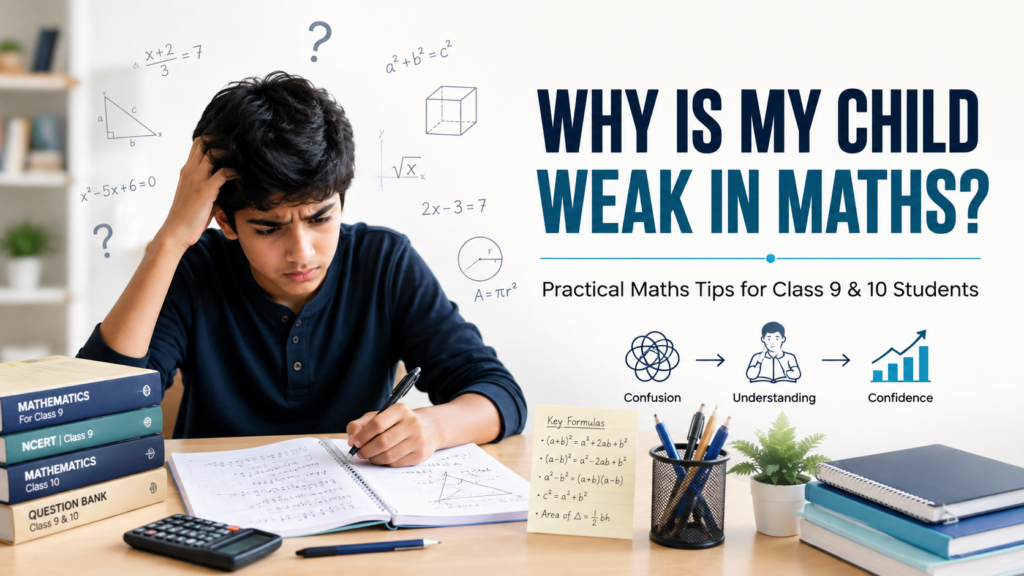
Table of Contents
Maths is one of those subjects that can either become a student’s strongest subject or their biggest source of stress. Many parents notice that their child understands other subjects well but struggles with calculations, problem-solving, formulas, or exam questions.
The good news is that being weak in Maths is rarely about being “bad at Maths.” In most cases, it is connected to gaps in fundamentals, lack of regular practice, fear of making mistakes, or an ineffective study approach.
Whether your child is in Class 9 or Class 10, the right strategy can make Maths much easier and more manageable.
Why Is My Child Weak in Math?
If you often wonder, why is my child weak in Math, start by looking beyond marks.
1. Weakness in Basic Concepts
Maths works like a chain. If a student has not understood fractions, integers, algebraic operations, percentages, or basic equations properly, advanced topics can become difficult.
A student may be able to memorise a formula but still struggle to understand when and how to use it.
2. Lack of Regular Practice
Maths cannot usually be mastered by studying only before a test. Students need consistent practice to develop calculation speed, accuracy, and problem-solving skills.
Even 30–45 minutes of focused Maths practice every day can make a significant difference over time.
3. Memorising Instead of Understanding
Some students try to memorise every formula and solution. This may work for a short time, but unfamiliar questions can become difficult.
Instead of asking only, “Which formula should I use?”, students should learn to ask:
- What information is given?
- What is being asked?
- Which concept applies?
- Why does this method work?
4. Fear of Making Mistakes
A student who repeatedly gets questions wrong may start thinking, “I am not good at Maths.”
This creates a cycle:
Fear → Avoidance → Less Practice → More Mistakes → More Fear
Breaking this cycle is essential.
5. Difficulty Understanding Word Problems
Many students know the mathematical concepts but struggle when the same concepts appear in a lengthy word problem.
Teaching students to identify keywords, given information, required information, and the correct mathematical relationship can improve their confidence.
6. Lack of a Proper Study Routine
Random practice often produces random results.
Students benefit from a structured routine that includes concept learning, solved examples, independent practice, revision, and mistake analysis.
Maths Tips for Class 9 Students
Class 9 is an important stage because the concepts introduced here form a foundation for Class 10 and future academic years.
Here are some practical maths tips for Class 9 students.
1. Strengthen the Basics First
Before moving to difficult questions, make sure fundamental concepts are clear.
Pay particular attention to:
- Number systems
- Algebraic expressions
- Linear equations
- Polynomials
- Coordinate geometry
- Geometry concepts
- Statistics
If a chapter feels difficult, go back to the prerequisite concept instead of simply memorising solutions.
2. Understand Every Formula
Do not maintain a formula notebook just for memorisation.
Write the formula, understand what each variable represents, and solve at least a few questions using it.
3. Practice Different Types of Questions
Solving ten identical questions may not prepare you for an exam.
Once the basic method is understood, practice questions with different levels of difficulty and different wording.
4. Maintain a Mistake Notebook
This is one of the most useful habits for Class 9 students.
Whenever you make a mistake, write down:
Question → Mistake → Correct Method → Reason for Mistake
Review these mistakes every week.
5. Do Not Ignore Geometry
Geometry can become challenging if diagrams and concepts are not understood properly.
Draw clean diagrams and learn the reasoning behind theorems rather than simply memorising their statements.
Maths Tips for Class 10 Students
For Class 10 students, Maths preparation becomes more focused because board examination performance matters significantly.
These maths tips for Class 10 students can help create a stronger preparation strategy.
1. Know Your Syllabus
Break the syllabus into manageable chapters and track your progress.
Instead of thinking, “I have the entire Maths syllabus left,” focus on completing one topic or chapter at a time.
2. Build Conceptual Clarity Before Speed
Students often try to solve questions quickly. However, speed should come after accuracy.
First learn to solve correctly. With consistent practice, speed naturally improves.
3. Practice NCERT Thoroughly
For CBSE students, NCERT should form an important part of preparation.
Students should understand examples, exercises, concepts, and different question formats rather than simply looking at answers.
4. Solve Previous Questions and Sample Papers
Once the syllabus is reasonably prepared, start practising exam-style questions.
This helps students understand:
- Question patterns
- Time management
- Frequently tested concepts
- Presentation
- Common mistakes
5. Work on Step-Wise Presentation
In Maths, the final answer is not always the only important part.
Students should show relevant steps clearly, use appropriate formulas, and keep calculations organised.
6. Take Timed Tests
Practising without a time limit can create a false sense of preparation.
Regular timed tests help students improve both accuracy and exam speed.
How to Score Good Marks in Maths
Many students ask, how to score good marks in Maths without spending hours studying every day.
The answer is not simply “study more.” It is about studying strategically.
Follow the 5-Step Maths Strategy
Step 1: Learn the concept
Understand what the chapter is teaching.
Step 2: Study solved examples
Observe how the concept is applied.
Step 3: Solve independently
Close the book and attempt questions yourself.
Step 4: Analyse mistakes
Do not simply check whether the answer is right or wrong. Find out why you made the mistake.
Step 5: Revise regularly
Revisit difficult concepts before they are forgotten.
Practice Every Day
Consistency is more effective than last-minute preparation.
A student who practises Maths regularly can gradually improve:
- Calculation speed
- Accuracy
- Confidence
- Problem-solving ability
- Exam performance
Focus on Accuracy
Careless mistakes can cost valuable marks.
Encourage students to check:
- Signs
- Decimal calculations
- Units
- Formula substitution
- Arithmetic
- Final answers
Learn Time Management
During an exam, avoid spending too much time on one difficult question.
A better strategy is to solve questions you know first and return to challenging questions later.
How to Overcome Fear of Maths
For some students, the biggest challenge is not the subject itself but the anxiety associated with it.
If you are wondering how to overcome fear of Maths, begin by changing the student’s relationship with mistakes.
1. Stop Calling Yourself “Bad at Maths”
Statements such as “I can never understand Maths” can become self-fulfilling.
Replace them with:
“I don’t understand this yet, but I can learn it with practice.”
This small change can encourage a growth mindset.
2. Start With Easy Questions
If a student is already anxious, immediately giving them difficult problems can increase frustration.
Begin with questions they can solve successfully and gradually increase the difficulty.
Small wins build confidence.
3. Ask Questions Without Fear
Students should feel comfortable asking when they do not understand something.
There is no benefit in carrying a doubt from one chapter into the next.
4. Practise in Short Sessions
Instead of forcing a student to study Maths for several hours, use focused sessions.
For example:
30 minutes concept learning + 30 minutes practice + 10 minutes mistake review
A consistent routine is easier to maintain.
5. Make Mistakes Part of Learning
Getting a question wrong does not mean the student is weak.
Every mistake provides information about what needs more attention.
Parents and teachers should focus on the process rather than only the marks.
A Simple Weekly Maths Routine for Students
A structured weekly routine can make preparation much easier.
Day | Focus |
Monday | Learn a new concept |
Tuesday | Practice basic questions |
Wednesday | Practice application-based questions |
Thursday | Revise previous concepts |
Friday | Solve challenging questions |
Saturday | Take a short Maths test |
Sunday | Review mistakes and revise formulas |
The exact schedule can be adjusted according to the student’s school timetable and learning needs.
When Should Parents Consider Extra Maths Support?
If a student consistently struggles despite regular practice, it may be useful to identify the exact learning gap rather than simply giving them more worksheets.
Extra support can be particularly helpful when a student:
- Has difficulty understanding basic concepts
- Avoids Maths homework
- Takes unusually long to solve questions
- Makes repeated calculation mistakes
- Has significant exam anxiety
- Understands examples but cannot solve questions independently
- Has lost confidence after poor test results
A personalised learning approach can help identify the student’s specific weaknesses and work on them step by step.
Final Thoughts
If you have been asking “Why is my child weak in Maths?”, remember that low marks do not necessarily indicate a lack of ability.
With strong fundamentals, regular practice, proper guidance, and a positive approach toward mistakes, students can improve their Maths skills significantly.
For Class 9 students, the priority should be building a strong conceptual foundation. For Class 10 students, the focus should gradually shift toward syllabus completion, exam-oriented practice, accuracy, and time management.
Most importantly, Maths should not be treated as a subject that students are either “born good at” or “bad at.”
Maths is a skill that improves with understanding, practice, patience, and the right guidance.
At Tutor Today, personalised learning can help students identify their weak areas, strengthen fundamentals, practise systematically, and develop greater confidence in Maths.
#1 Tuition Centre For CBSE Education
READ MORE :
- online English speaking course
- Benefits Of Offline tuition
- How to Find you find the best online tutor
- Tutoring Services Near Me
- offline coaching classes in Noida
- Best Tutor Near Me
- tuition class near me
- online and offline tuition
- Best Offline Tuition Classes in Delhi
- Tuition Classes in Noida Sector 26
- Best CBSE Tuition in Noida
Frequently Asked Questions
1. Why does my child understand Maths in class but struggle at home?
This can happen when a student can follow a teacher's explanation but has difficulty applying the concept independently. More independent practice and identifying the exact point where they get stuck can help.
2. Why does my child make silly mistakes in Maths even after studying?
Careless mistakes can come from rushing, weak calculation habits, poor question reading, or anxiety. Reviewing mistakes rather than simply checking marks can help identify the pattern.
3. How can I tell whether my child has Maths anxiety or simply needs more practice?
Avoidance, fear before Maths tests, negative self-talk, or freezing despite knowing the concept can indicate Maths anxiety.
4. How much Maths should a Class 9 or 10 student practise every day?
There is no single ideal number of hours. Consistent, focused practice is generally more useful than occasional long study sessions.
5. What should my child do if they understand NCERT but cannot solve new Maths questions?
The student should practise application and competency-based questions instead of relying only on familiar examples. CBSE's competency-based materials specifically emphasize conceptual understanding and application
6. How can parents help a child who says, “I hate Maths”?
Avoid labelling the child as weak at Maths. Focus on progress, encourage questions, normalise mistakes, and connect Maths with practical situations.
7. Should my child memorise Maths formulas or understand them?
Understanding should come first. Formula memorisation becomes much more effective when students know what the formula means and when to apply it.
8. Why is my child's Maths score not improving despite doing lots of questions?
More questions do not always mean better learning. The student may need to work on concept gaps, question interpretation, calculation accuracy, or analysing previous mistakes.
LinkedIn
WhatsApp
Facebook
Pinterest
X
Tumblr
Tutor Today Blogs