
AI Tools for Students: How Artificial Intelligence Is Changing School Education
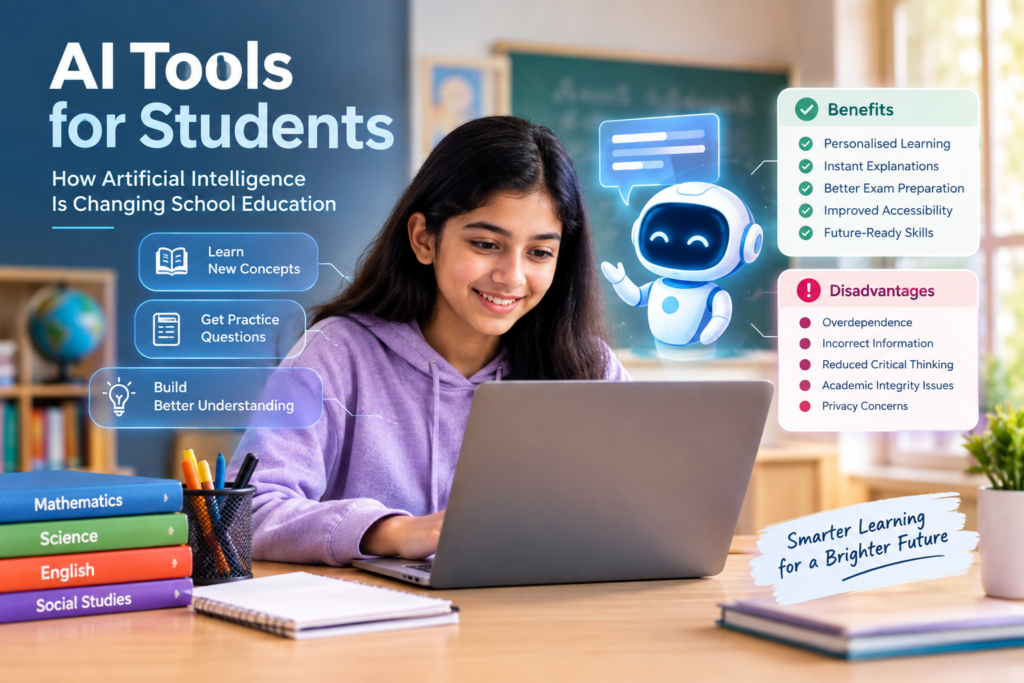
Table of Contents
Tutor Today : Artificial intelligence (AI) is no longer limited to technology companies, research laboratories, or science-fiction movies. It is becoming part of everyday life—and education is one of the areas where its impact is becoming increasingly visible.
From explaining difficult mathematics problems to helping students create revision questions, AI tools for students are changing how learners access information, practise concepts, and prepare for examinations. At the same time, the growing use of AI in schools has raised important questions about academic integrity, independent thinking, privacy, accuracy, and the role of teachers.
For students, the important question is no longer simply whether AI should be used in education. The bigger question is how AI should be used responsibly so that it supports learning rather than replacing it.
This is particularly relevant in India. CBSE’s 2026–27 academic framework includes Computational Thinking and Artificial Intelligence, with a dedicated curriculum framework for Classes III–VIII. CBSE also lists Computational Thinking & AI in its current secondary curriculum.
UNESCO has similarly developed an AI Competency Framework for Students that focuses on helping learners become responsible and creative users and co-creators of AI. The framework covers four broad dimensions: a human-centred mindset, ethics of AI, AI techniques and applications, and AI system design.
What Are AI Tools for Students?
AI tools for students are applications and digital platforms that use artificial intelligence to assist with learning, research, writing, problem-solving, revision, language practice, or other educational activities.
Unlike traditional educational software, modern generative AI systems can respond to questions in natural language and generate new content based on a user’s instructions.
For example, a student studying science may ask an AI tool to explain photosynthesis in simple language. A mathematics student can request additional practice questions on algebra. A language learner can practise conversations or ask for feedback on grammar.
Common educational uses of AI include:
- Explaining difficult concepts in simpler language
- Creating practice questions and quizzes
- Generating revision notes
- Summarising lengthy study material
- Helping students brainstorm ideas
- Providing writing and grammar feedback
- Supporting language learning
- Creating personalised study plans
- Generating examples for difficult topics
- Helping students identify mistakes in their work
However, AI-generated content should not automatically be considered correct. Students need to verify important information and develop the ability to judge whether an AI response is reliable.
UNESCO’s student competency framework specifically emphasises critical judgement of AI solutions and responsible participation in an AI-enabled society.
AI and School Education
The relationship between AI and school education is changing rapidly. Traditionally, students depended mainly on textbooks, classroom teaching, libraries, coaching, and educational websites for academic support. AI adds another layer: an interactive digital assistant that can respond to individual questions almost immediately.
This can make learning more personalised.
Consider two students studying the same chapter. One may understand a concept after reading the textbook once, while another may need several examples and a simpler explanation. An AI system can potentially provide different explanations based on the student’s questions and level of understanding.
However, this does not mean AI should replace teachers.
Teachers understand classroom dynamics, student behaviour, emotional needs, misconceptions, and learning difficulties in ways that automated systems cannot fully replicate. UNESCO’s AI competency work for teachers also recognises that AI is changing the traditional teacher-student relationship into a teacher-AI-student dynamic, creating a need for new competencies.
AI in Indian Schools
The discussion around AI in Indian schools has moved beyond experimentation. CBSE has introduced a Curriculum Framework for Computational Thinking and Artificial Intelligence for Classes III–VIII for the 2026–27 session and provides student and teacher resource books for the programme.
CBSE’s 2026–27 secondary curriculum also includes Computational Thinking & AI and lists Artificial Intelligence among optional subjects.
This development reflects a broader shift in education: students are increasingly expected not only to consume technology but also to understand how it works, where it can be useful, and what risks it creates.
AI Literacy Is Becoming an Important Student Skill
Being able to use an AI chatbot is not the same as being AI literate.
AI literacy for students should include understanding what AI can and cannot do, recognising that AI-generated information can contain errors, protecting personal information, evaluating sources, and considering the ethical consequences of using AI.
UNESCO’s framework identifies 12 competencies across four dimensions and three progression levels—Understand, Apply, and Create. This approach encourages students to move beyond simply using AI towards understanding and critically evaluating it.
Benefits of AI in Education
There are several significant benefits of AI in education when the technology is used thoughtfully and under appropriate guidance.
1. Personalised Learning
One of the biggest potential advantages of AI is personalised learning.
Students do not all learn at the same speed. Some may need additional explanations, while others may want more challenging questions. AI can help generate different examples, explanations, or practice activities based on the student’s needs.
For example, instead of asking an AI system for the answer to a mathematics problem, a student could ask:
“Give me a hint and explain the method without giving me the final answer.”
This approach allows AI to support learning without taking away the student’s opportunity to solve the problem.
2. Instant Explanations
Students often hesitate to ask questions in a classroom because they may feel embarrassed or believe their question is too basic.
An AI learning assistant can provide an immediate explanation and allow students to ask follow-up questions.
A student can request:
- A simple explanation
- A real-world example
- A step-by-step explanation
- A comparison between two concepts
- Additional practice questions
This can make difficult subjects feel more approachable.
3. Better Revision and Exam Preparation
AI can help students prepare for examinations by generating practice questions, flashcards, quizzes, revision schedules, and topic-wise exercises.
For example, a Class 10 student preparing for a science examination could ask an AI tool to create a 20-question practice test based on a particular chapter.
The student can then attempt the questions independently and use AI to identify areas that need further revision.
4. Support for Different Learning Styles
Students may understand information better when it is presented in different ways.
A difficult concept can potentially be explained using:
- A simple analogy
- A story
- A real-life example
- A comparison
- A step-by-step explanation
- A question-and-answer format
AI can generate multiple explanations quickly, giving students more ways to approach the same concept.
5. Assistance With Writing and Language
AI can help students identify grammar mistakes, improve sentence structure, understand unfamiliar words, and practise writing.
However, students should distinguish between learning from AI feedback and simply asking AI to write an entire assignment.
For example, asking an AI tool to explain why a sentence is grammatically incorrect can be educational. Copying an AI-generated essay and submitting it as one’s own is a very different use.
6. Greater Accessibility
AI can potentially make educational material more accessible by translating information, simplifying complex language, creating summaries, and providing alternative explanations.
This can be especially useful for students who struggle with highly technical or unfamiliar language.
7. Development of Future Skills
AI is becoming relevant across many professions. Learning how to work with AI responsibly can therefore help students develop skills that may be valuable beyond school.
These include:
- Critical thinking
- Problem-solving
- Digital literacy
- Information evaluation
- Prompting and communication
- Ethical decision-making
- Creativity
- Collaboration with technology
UNESCO’s framework describes students not simply as consumers of AI but as potential responsible and creative co-creators of AI.
How Students Can Use AI for Studying
The most effective ways students can use AI for learning involve using it as a tutor, practice partner, or feedback tool.
Use AI to Understand Difficult Topics
Instead of asking:
“Give me the answer.”
students can ask:
“Explain this concept in simple language and give me two examples.”
This encourages understanding rather than copying.
Use AI to Create Practice Questions
Students can provide a topic and request questions at different difficulty levels.
For example:
“Create 10 Class 9 questions on motion: five basic, three intermediate, and two challenging. Do not provide the answers until I attempt them.”
Use AI as a Revision Partner
Students can ask AI to quiz them one question at a time. This creates a more active learning experience than simply reading notes repeatedly.
Use AI to Identify Mistakes
A student can attempt a problem independently and then ask AI to check the reasoning.
The objective should be to understand why something is wrong, rather than simply replacing the student’s answer with an AI-generated one.
How to Use ChatGPT for Studying Without Cheating
Students wondering how to use ChatGPT for studying without cheating should focus on using AI for assistance rather than substitution.
Good uses include:
- Asking for explanations
- Requesting hints
- Creating practice tests
- Checking grammar
- Generating examples
- Brainstorming ideas
- Asking for feedback
- Revising concepts
Students should follow their school’s or teacher’s rules about AI use. If an assignment is intended to assess independent writing or problem-solving, submitting AI-generated work as original work can undermine the purpose of the assignment.
Disadvantages of AI for Students
Although there are many benefits, the disadvantages of AI for students should not be ignored.
The educational value of AI depends largely on how it is used.
1. Overdependence on AI
The biggest concern is dependence.
If students use AI every time they encounter a difficult question, they may stop developing the habit of thinking through problems independently.
Learning requires effort. Struggling with a problem, making mistakes, correcting them, and trying again are important parts of developing understanding.
AI should therefore provide support without removing productive effort from the learning process.
2. AI Can Provide Incorrect Information
AI systems can generate convincing answers that are factually incorrect.
This is particularly important for students because an incorrect explanation can lead to misunderstanding of an entire topic.
Students should cross-check important information against textbooks, teachers, official educational websites, and other reliable sources.
3. Reduced Critical Thinking
If students accept AI answers without questioning them, they may become passive consumers of information.
A responsible student should ask:
- Is this information correct?
- What is the evidence?
- Is there another explanation?
- Does this match my textbook?
- Can I verify this from a reliable source?
Developing this habit is more important than simply learning how to write better prompts.
4. Academic Integrity Problems
AI creates new challenges for homework, assignments, projects, and examinations.
If a student asks AI to complete an assignment and submits the result as their own work, the student may receive a grade without actually developing the required skill.
Schools and teachers therefore need clear policies explaining acceptable and unacceptable AI use.
5. Privacy and Data Concerns
Students should avoid sharing sensitive personal information with AI tools.
They should not unnecessarily enter:
- Passwords
- Personal identification information
- Private school records
- Financial information
- Private conversations
- Other people’s personal information
Digital literacy must include understanding how personal data can be collected and used.
6. Bias and Unreliable Responses
AI systems learn from large quantities of data and can sometimes reproduce biases or provide incomplete perspectives.
Students should therefore learn to compare different sources and recognise that an AI response is not automatically an objective or authoritative answer.
7. Reduced Human Interaction
Education is about more than acquiring information.
Students learn through conversations with teachers, discussions with classmates, teamwork, extracurricular activities, experiments, and real-world experiences.
Excessive reliance on AI could reduce some of these important human interactions.
AI Tools Should Support Teachers, Not Replace Them
The debate around AI vs teachers often presents the issue as a competition between humans and technology. In education, this is an overly simplistic way of looking at the situation.
AI can process information quickly and generate explanations, questions, and educational material. Teachers bring human judgement, empathy, classroom experience, mentorship, and an understanding of individual students.
A more useful model is therefore teacher + student + AI.
Teachers can guide students on when AI is appropriate, how to verify information, how to avoid plagiarism, and how to use technology to strengthen rather than weaken their learning.
UNESCO’s teacher competency framework similarly focuses on preparing teachers to understand both the opportunities and risks associated with AI in education.
How Parents Should Guide Children Using AI
Parents also have an important role in teaching children how parents should guide children using AI.
Instead of simply banning AI, parents can encourage responsible habits.
They can ask children:
- What did you use AI for?
- Did you check whether the answer was correct?
- Can you explain the answer in your own words?
- What did you learn from the AI response?
- Could you solve the problem yourself?
- Did you follow your school’s rules?
Parents can also encourage children to use AI alongside books, teachers, educational websites, experiments, and independent study.
The goal should be to develop AI literacy, not AI dependence.
AI Skills Students Should Learn in 2026
As AI becomes increasingly integrated into education and everyday life, there are several AI skills students should learn in 2026.
1. Asking Better Questions
Students should learn how to communicate clearly with AI and provide sufficient context.
2. Fact-Checking
Students should never assume that an AI response is automatically correct.
3. Critical Thinking
They should learn to question information, compare sources, and identify weaknesses in an argument.
4. Responsible AI Use
Students need to understand academic integrity, privacy, copyright, and ethical considerations.
5. Basic Understanding of AI
Students should understand basic concepts such as data, algorithms, machine learning, generative AI, and AI limitations.
6. Creativity and Problem-Solving
AI should be used to support creativity rather than replace it. Students should continue developing their own ideas, opinions, solutions, and projects.
UNESCO’s framework reflects this broader approach by combining human-centred thinking, AI ethics, technical understanding, and AI system design.
What Is the Future of AI in School Education?
The future of AI and school education is likely to involve closer interaction between students, teachers, educational technology, and AI systems.
The direction already being taken by education systems suggests that AI literacy will become an increasingly important part of preparing students for the future. In India, CBSE’s current curriculum framework for Computational Thinking and AI for Classes III–VIII is an important example of this shift.
However, successful AI integration will require more than simply giving students access to AI tools.
Schools will need:
- Clear AI-use policies
- Teacher training
- Digital literacy
- Student guidance
- Privacy safeguards
- Reliable learning resources
- Assessment methods that encourage genuine understanding
- A balance between technology and human interaction
UNESCO’s approach similarly stresses that education systems need to prepare students to engage with AI safely, meaningfully, critically, and creatively.
Conclusion
AI tools for students have the potential to make education more personalised, interactive, accessible, and flexible. Students can use AI to understand difficult concepts, practise questions, revise lessons, improve writing, and explore subjects beyond the classroom.
But technology alone cannot make a student successful.
The benefits of AI in education are strongest when AI encourages students to ask questions, practise skills, explore ideas, and understand concepts. The disadvantages of AI for students become more serious when learners depend on AI for every answer, submit AI-generated work without understanding it, or accept information without verification.
The future of education should therefore not be about choosing between teachers and AI. It should be about using technology responsibly while keeping teachers, critical thinking, curiosity, creativity, and independent learning at the heart of education.
For today’s students, the most valuable skill may not simply be knowing how to use AI. It may be knowing when to use it, how to question it, and when to think for themselves.
References
- UNESCO – AI Competency Framework for Students. The framework outlines competencies for students across human-centred mindset, ethics of AI, AI techniques and applications, and AI system design.
UNESCO: AI Competency Framework for Students - UNESCO – Artificial Intelligence and the Futures of Learning. Provides UNESCO’s broader work and policy guidance on AI in education and learning.
UNESCO: AI and the Future of Learning - CBSE – Computational Thinking and Artificial Intelligence (CT&AI), 2026–27. CBSE provides the current curriculum framework and student/teacher resources for Classes III–VIII.
CBSE: Computational Thinking and Artificial Intelligence - CBSE – Curriculum for Academic Year 2026–27. The current secondary curriculum includes Computational Thinking & AI and Artificial Intelligence among the listed subjects/modules.
CBSE: Curriculum 2026–27 - UNESCO – AI Competency Framework for Teachers. Provides guidance on the competencies teachers need to use AI appropriately in education.
UNESCO: AI Competency Framework for Teachers
Facebook
X
LinkedIn
Reddit
WhatsApp
Tumblr
Tutor Today Blogs