
10 Best AI Tools for Homework in 2026: Study Smarter, Not Harder
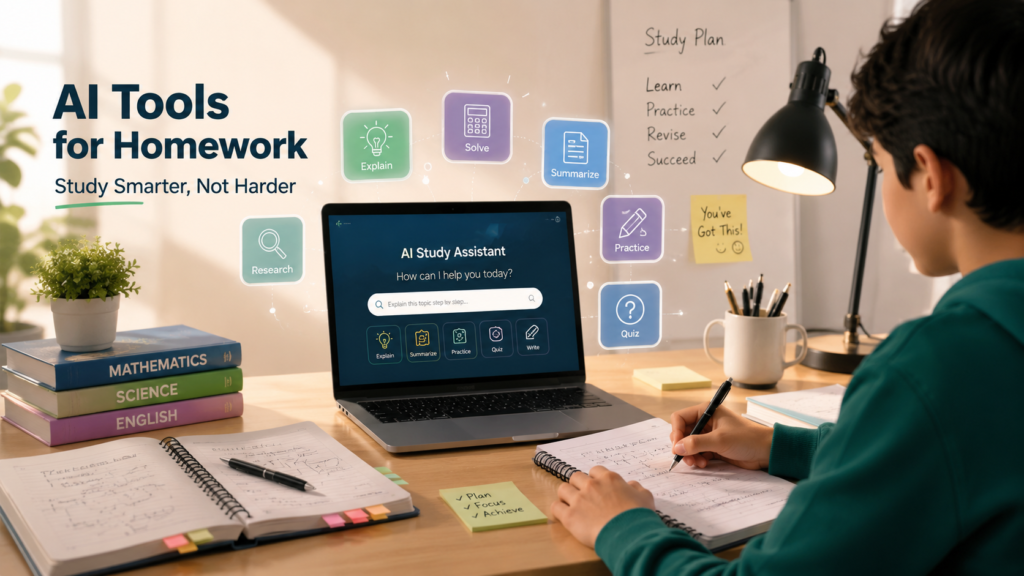
Table of Contents
Artificial intelligence is changing the way students learn, practise, revise, and complete homework. From explaining difficult Maths problems to creating practice quizzes and helping students understand complicated topics, AI tools for homework can make studying more interactive and personalized.
But there is an important difference between using AI to learn and using AI simply to get answers.
A student who asks an AI tool to complete an entire assignment may finish homework faster, but may not actually understand the subject. On the other hand, a student who uses AI to ask questions, identify mistakes, practise similar problems, and understand difficult concepts can use technology as an additional learning resource.
Modern AI learning features are increasingly designed around this second approach. For example, ChatGPT’s Study Mode can guide students through problems step by step, ask questions, check understanding, create practice questions, and work with uploaded study materials. (OpenAI)
So, what are the best AI tools for homework, and how should students use them?
Let’s explore.
What Are AI Tools for Homework?
AI homework tools are applications that use artificial intelligence to help students understand, practise, research, revise, or organize their schoolwork.
Depending on the tool, students can use AI to:
- Understand difficult concepts
- Get step-by-step explanations
- Solve or check Maths problems
- Generate practice questions
- Create quizzes
- Summarize study material
- Improve writing
- Check grammar
- Create revision notes
- Organize a study plan
- Research a topic
- Identify mistakes in their work
However, AI-generated answers are not automatically correct. Students should verify important information and follow their school’s rules regarding AI use. OpenAI’s own guidance notes that Study Mode can make mistakes and recommends double-checking important information. (OpenAI Help Center)
10 Best AI Tools for Homework
1. ChatGPT
Best for: Explanations, homework guidance, Maths, Science, writing, revision and practice.
ChatGPT is one of the most versatile AI tools for students because it can adapt explanations to a student’s level and learning needs.
Instead of simply asking:
“Give me the answer.”
Students can ask:
“Explain this concept step by step and then give me a similar question to solve myself.”
This approach encourages understanding instead of answer copying.
ChatGPT’s Study Mode is particularly relevant for students because it can guide them through problems, ask questions, provide feedback, create practice questions, and work with uploaded notes, worksheets, images and PDFs. (OpenAI Help Center)
Students can use ChatGPT for:
- Maths problem-solving
- Science explanations
- English practice
- Homework guidance
- Exam preparation
- Revision
- Flashcards
- Practice tests
- Study planning
Best tip: Ask ChatGPT to give you a hint before giving you the final answer.
2. Google Gemini
Best for: Research, explanations, brainstorming and general study assistance.
Gemini can help students explore topics, generate explanations, organize ideas, and brainstorm ways to approach an assignment.
For example, instead of asking it to write an entire project, a student could ask:
“Help me create an outline for a school project about climate change.”
The student can then research, write and develop the project independently.
This distinction is important because AI should support a student’s thinking rather than replace it.
3. Microsoft Copilot
Best for: Research, writing assistance and productivity.
Microsoft Copilot can be useful when students need help organizing information, generating ideas, improving written drafts, or understanding a topic.
For example, a student working on an English assignment could use AI to identify areas where a paragraph needs clearer structure and then rewrite it independently.
It can be particularly useful for students who already work extensively with Microsoft’s productivity tools.
4. Perplexity
Best for: Research and finding information.
Research-heavy homework can be challenging because students often don’t know where to begin.
AI search tools can help students explore a subject and identify useful sources or questions for further research.
However, students should still check the original sources before using information in a school project.
A good research workflow is:
AI → Find ideas → Check original sources → Understand → Write in your own words
Not:
AI → Copy → Submit
5. Photomath
Best for: Understanding Maths problems.
Maths homework often becomes difficult when a student gets stuck on one step.
Tools designed specifically for Maths can help students examine a problem and understand how a solution is approached.
But students should avoid using a Maths AI tool simply to obtain answers.
Instead, ask:
- Why was this formula used?
- Where did I make a mistake?
- What should I do first?
- Can you give me a similar problem?
This turns an AI Maths solver into a practice resource rather than an answer machine.
6. Khanmigo
Best for: Guided learning and tutoring-style interactions.
AI tutoring tools are increasingly moving beyond simply displaying answers.
The goal is to create a more interactive learning experience where students receive hints, explanations and questions that encourage them to think.
This type of approach is especially useful when students are struggling with a concept rather than simply looking for a final answer.
7. Quizlet
Best for: Revision, flashcards and self-testing.
Students often spend too much time rereading notes and too little time testing themselves.
AI-powered study features can help turn learning material into:
- Flashcards
- Practice questions
- Quizzes
- Revision activities
For example, after completing a chapter, a student could create questions from the topic and test their understanding.
This can make revision more active.
8. Grammarly
Best for: English writing and grammar.
For students working on essays, assignments or written projects, grammar and writing tools can help identify issues with:
- Grammar
- Spelling
- Sentence structure
- Clarity
- Word choice
- Tone
But students should understand why something is incorrect.
Instead of simply accepting every AI suggestion, ask:
“Why is this sentence grammatically incorrect?”
Understanding the correction helps improve writing skills over time.
9. Wolfram Alpha
Best for: Mathematics, calculations and technical subjects.
Students working with advanced Maths can use computational tools to explore mathematical problems and verify calculations.
It can be especially useful for checking results and exploring mathematical concepts.
However, checking an answer should not replace learning the method used to reach that answer.
For school students, understanding the process is often more important than knowing the final number.
10. Canva AI
Best for: Presentations, projects and visual assignments.
Not all homework involves solving questions.
Students may also need to create:
- Presentations
- Posters
- Project covers
- Infographics
- Visual summaries
AI-assisted design tools can help students brainstorm layouts and visual ideas.
The student should still be responsible for the research, accuracy and educational content of the project.
How Students Can Use AI for Homework Without Cheating
This is perhaps the most important part of using AI tools for homework.
AI becomes useful when it helps a student learn something they couldn’t understand on their own.
Consider a Maths problem.
Poor use of AI:
“Solve this question and give me the answer.”
The student may submit the answer without understanding anything.
Better use:
“I’m stuck on this Maths problem. Don’t give me the final answer. Explain the first step and let me try.”
Even better:
“Check my solution and tell me where I made my first mistake.”
This creates an opportunity for learning.
The same principle applies to Science, English, Social Science and other subjects.
How to Use AI Tools for Maths Homework
Maths is one of the subjects where AI can be particularly useful—but also one where students can become dependent on answer-generating tools.
A better approach is to use AI for guided practice.
1. Understand a concept
Ask:
“Explain fractions to me as if I am learning them for the first time.”
2. Get a hint
Ask:
“Give me a hint for solving this problem without giving me the answer.”
3. Find your mistake
Ask:
“Here is my working. Find the first step where I went wrong.”
4. Practise
Ask:
“Give me five similar questions, starting with an easy one.”
5. Test yourself
Ask:
“Give me a 10-question Maths quiz and ask one question at a time.”
This approach is much closer to actual tutoring.
For students who need more personalized guidance, AI can complement—but not necessarily replace—human tutoring.
How to Use AI for Science Homework
Science students can use AI to break complicated concepts into simpler explanations.
For example:
“Explain photosynthesis for a Class 8 student.”
Then follow up:
“Now explain it using a real-life example.”
Then:
“Quiz me on this topic.”
This creates a simple learning cycle:
Learn → Explain → Practise → Test → Correct
Students can also ask AI to compare related concepts, create revision questions, or explain diagrams.
However, factual information should be checked against reliable textbooks, teacher-provided material and trusted sources.
How to Use AI for English Homework
AI can also support English learning.
Students can use it to:
- Practise vocabulary
- Understand difficult words
- Improve grammar
- Generate writing prompts
- Practise conversations
- Review essays
- Identify common writing mistakes
- Create comprehension questions
For example:
“Give me 10 vocabulary words suitable for a Class 9 student and test me one at a time.”
This turns AI into an interactive practice partner.
How AI Can Help With Exam Preparation
AI isn’t only useful when homework is due.
Students can also use AI tools to prepare for exams.
A student could provide a list of topics and ask AI to create:
- A revision schedule
- Practice questions
- Mock tests
- Flashcards
- Topic summaries
- Self-assessment questions
ChatGPT’s Study Mode, for example, can be used for exam preparation, reviewing notes, creating practice questions and checking understanding. (OpenAI Help Center)
A useful revision cycle is:
Understand → Practise → Test → Identify Weaknesses → Revise → Test Again
10 Useful AI Prompts for Students
Students don’t always get useful results because they ask vague questions.
Here are better prompts.
For understanding
“Explain this topic in simple language suitable for a Class 8 student.”
For Maths
“Help me solve this Maths problem step by step. Don’t give me the final answer immediately.”
For mistakes
“Check my solution and tell me where I made my first mistake.”
For practice
“Give me 10 questions on this topic, starting easy and gradually becoming harder.”
For revision
“Turn this chapter into a concise revision guide with key concepts and important terms.”
For testing
“Quiz me one question at a time. Don’t show the answer until I respond.”
For Science
“Explain this Science concept using a simple real-life example.”
For English
“Check my paragraph for grammar mistakes and explain each correction.”
For exam preparation
“Create a 7-day study plan for these topics. Include revision and practice tests.”
For deeper learning
“Don’t just give me the answer. Ask me questions that help me work it out myself.”
Can AI Replace a Tutor?
This is a question many parents are asking.
The short answer is: AI can be a useful learning assistant, but it should not automatically be treated as a replacement for personalized teaching.
AI can provide explanations quickly and help students practise at almost any time.
But a human tutor can observe things that an AI system may not fully capture in the same way:
- A student’s confidence
- Repeated conceptual mistakes
- Learning habits
- Attention difficulties
- Whether the student actually understands the topic
- When to slow down
- When to introduce a harder problem
- How to motivate the student
The strongest approach may therefore be technology + human guidance, rather than technology versus teachers.
UNESCO’s guidance on generative AI in education similarly emphasizes a human-centred and age-appropriate approach, including attention to safety, ethics and meaningful educational use. (UNESCO)
Should Parents Allow Children to Use AI for Homework?
Parents don’t necessarily need to treat AI as either completely good or completely bad.
Instead, they can establish simple rules.
Rule 1: Try the problem first
The child should attempt the homework before asking AI for help.
Rule 2: Ask for explanations
Encourage prompts such as:
“Explain this.”
rather than:
“Do this for me.”
Rule 3: Verify information
AI can make mistakes, so important information should be checked.
Rule 4: Follow school policies
Different schools and teachers may have different rules regarding AI-assisted assignments.
Rule 5: Protect personal information
Children should avoid entering unnecessary personal, private or sensitive information into AI systems.
Rule 6: Keep independent practice
Students still need to read textbooks, write answers, solve Maths problems and practise without AI.
UNESCO’s AI competency framework also emphasizes that students need critical judgement, ethical awareness and responsible use of AI—not simply the ability to operate AI tools. (UNESCO)
Common Mistakes Students Make With AI Homework Tools
1. Copying the first answer
An AI-generated answer may sound convincing even when it is incomplete or incorrect.
2. Asking AI to do everything
This prevents students from developing independent problem-solving skills.
3. Not checking the answer
Students should verify important facts and calculations.
4. Using AI before attempting the question
Trying independently first can reveal exactly where help is needed.
5. Using AI for every subject and every task
Students need independent reading, writing, calculation, reasoning and memory practice.
6. Ignoring school rules
AI use should always follow the policies of the student’s school or teacher.
The Best Way to Use AI for Homework
Think of AI as a study partner, not a shortcut.
A productive workflow looks like this:
Step 1: Try
Attempt the question yourself.
Step 2: Identify
Figure out exactly where you are stuck.
Step 3: Ask
Use AI to explain that specific difficulty.
Step 4: Understand
Read the explanation and ask follow-up questions.
Step 5: Practise
Solve a similar question without AI.
Step 6: Check
Compare your solution and identify mistakes.
Step 7: Repeat
Practise until you can solve the problem independently.
That’s how AI can become part of real learning rather than answer copying.
Final Thoughts: Should Students Use AI for Homework?
There is no question that AI tools for homework can make learning more accessible and interactive.
Students can use AI to understand difficult concepts, practise Maths, revise Science, improve English, prepare for exams and create personalized study routines.
But the goal should never be simply:
“How quickly can I finish my homework?”
The better question is:
“How can I use this tool to understand what I’m learning?”
AI works best when it encourages curiosity, practice, questioning and independent thinking.
For students, the ideal combination is not AI instead of learning. It is AI supporting better learning.
At Tutor Today, we believe technology can be a valuable learning companion—but strong fundamentals, regular practice, concept clarity and personalized guidance remain at the heart of academic growth.
Learn today. Lead tomorrow.
Ai Tools for Education
READ MORE :
- why is my child weak in Math
- online English speaking course
- Benefits Of Offline tuition
- How to Find you find the best online tutor
- Tutoring Services Near Me
- offline coaching classes in Noida
- Best Tutor Near Me
- tuition class near me
- online and offline tuition
- Best Offline Tuition Classes in Delhi
- Tuition Classes in Noida Sector 26
- Best CBSE Tuition in Noida
Frequently Asked Questions
1. What are the best AI tools for homework?
Some useful AI tools for homework include ChatGPT, Gemini, Copilot, Perplexity, Photomath, Khanmigo, Quizlet, Grammarly and Wolfram Alpha. The best tool depends on the subject and what the student needs help with.
2. Can AI solve homework questions?
Yes, many AI tools can help solve or explain homework questions. However, students should use them to understand the process rather than simply copying the final answer.
3. Is AI good for students?
AI can be useful for students when used responsibly. It can support explanations, practice, revision and exam preparation, but students still need independent learning and critical thinking.
4. Can ChatGPT help with Maths homework?
Yes. Students can use ChatGPT to understand Maths concepts, receive step-by-step guidance, check their working and generate similar practice questions. ChatGPT's Study Mode is specifically designed to guide students through learning rather than only provide final answers.
5. Can AI replace a Maths tutor?
AI can provide explanations and practice, but it does not automatically replace personalized teaching. A human Maths tutor can adapt instruction to a student's individual progress, misconceptions and learning needs.
6. How should students use AI without cheating?
Students should attempt the problem first, ask AI for explanations or hints, check their own work, practise independently and follow their school's AI-use policies.
LinkedIn
WhatsApp
Facebook
Pinterest
X
Tumblr
Tutor Today Blogs