
How to Prepare for CBSE Board Exams: A Smart Strategy to Score Better
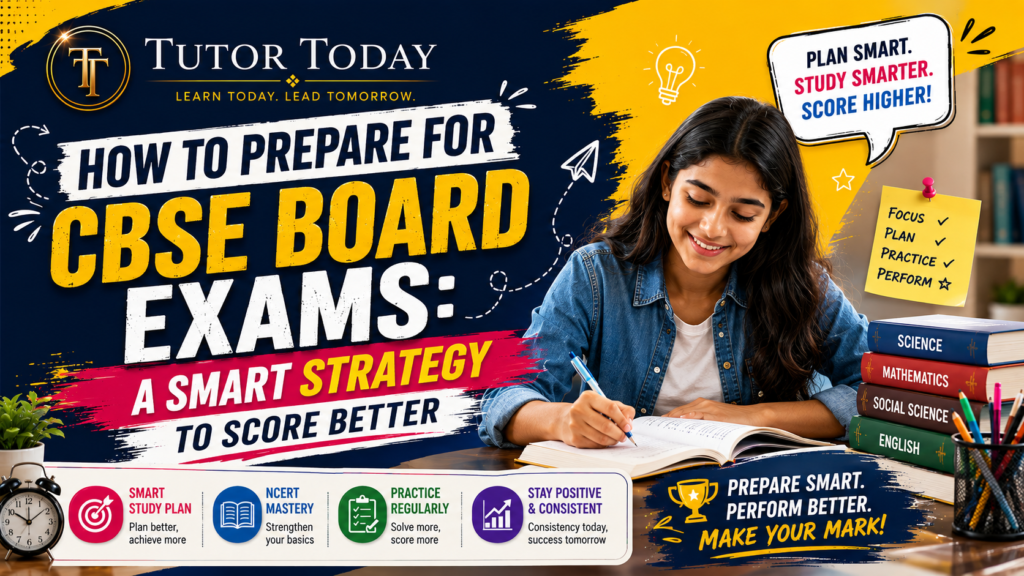
Table of Contents
CBSE board exams are not won by studying endlessly—they are won by studying with a plan. A strong preparation strategy combines syllabus coverage, conceptual understanding, regular practice, effective revision, and mock tests.
If you are wondering how to prepare for CBSE board exams, start by asking three questions: What do I need to study? What do I already know? And where am I losing marks?
Once you have these answers, your preparation becomes much more focused.
This guide covers a practical board exam preparation strategy, including what to do during the final month and how to revise effectively before the exams.
Build Your Board Exam Preparation Strategy Around 4 Steps
Instead of treating preparation as one long study period, divide it into four stages:
Learn → Practise → Revise → Test
1. Learn: Master Concepts Before Memorising
Start with the official CBSE syllabus and your prescribed textbooks. Break every subject into individual chapters and classify them as:
- Strong: You can solve questions independently.
- Needs Practice: You understand the concept but make mistakes.
- Weak: You struggle to understand or recall the topic.
This simple classification helps you prioritise your time.
Do not spend three hours perfecting a chapter you already understand while leaving difficult chapters untouched.
2. Practise: Turn Knowledge Into Exam Skills
Understanding a chapter does not guarantee marks.
You also need to practise applying what you have learned. Solve textbook questions, sample papers and previous-year questions regularly.
For every practice session, ask:
- Did I understand what the question was asking?
- Could I solve it without looking at the solution?
- Did I use the correct method?
- Did I complete the answer within the required time?
Maintain a mistake notebook. Write down recurring errors, difficult formulas, concepts you forget and questions that take too long.
Your mistakes are not just failures—they are a personalised revision list.
3. Revise: Make Information Easy to Recall
Revision should not mean reading the same chapter repeatedly.
Use active recall. After studying a topic, close your book and try to explain the concept from memory. Then check what you missed.
You can also use:
- Formula sheets
- Flashcards
- Mind maps
- Short revision notes
- Chapter-wise question banks
The aim is to gradually reduce your dependence on your books and notes.
4. Test: Simulate the Real Examination
Once you have covered the syllabus, start taking timed tests.
Treat a sample paper like an actual examination: sit at a desk, follow the time limit and avoid distractions.
After completing the paper, don’t focus only on your score.
Analyse why you lost marks.
For example:
Problem | What it tells you |
Conceptual mistake | Revise the topic |
Careless calculation | Improve checking |
Incomplete answer | Improve answer writing |
Took too long | Practise timed questions |
Forgot information | Strengthen active recall |
This turns every mock test into a learning session.
How to Prepare for CBSE Board Examination : A Month-by-Month Approach
Your preparation should change as the exam gets closer.
2–3 Months Before Exams: Complete and Strengthen
Your priority should be completing the syllabus and understanding difficult concepts.
At this stage:
- Finish remaining chapters.
- Identify weak areas.
- Create concise revision material.
- Begin chapter-wise question practice.
- Start solving selected previous-year questions.
Don’t wait until the final month to discover that a chapter is difficult.
4–6 Weeks Before Exams: Shift From Learning to Revision
Once most of the syllabus is complete, reduce the time spent learning completely new material.
Increase:
- Revision
- Question practice
- Sample papers
- Previous-year papers
- Timed tests
This is where your preparation starts becoming exam-oriented.
Last Month Board Exam Preparation: What Should You Focus On?
The last month board exam preparation period is critical because this is when you should convert your knowledge into confidence and speed.
A useful four-week approach is:
Week 1: Finish the Gaps
Complete any remaining chapters and revise your weakest topics.
Don’t aim for perfect notes. Aim for complete understanding and sufficient practice.
Week 2: First Full Revision
Revise every subject systematically.
Focus on:
- Important concepts
- Formulas
- Definitions
- Diagrams
- Key facts
- Important questions
- Previously incorrect questions
Use active recall rather than reading entire chapters passively.
Week 3: Mock-Test Mode
Start attempting full-length papers under examination conditions.
After every test:
Check → Analyse → Correct → Reattempt
If you repeatedly lose marks in the same area, stop taking more tests temporarily and fix that weakness.
Week 4: Final Revision
The final week should be about consolidation—not panic.
Revise your short notes, formulas, difficult concepts and mistake notebook.
Avoid suddenly starting multiple new books, courses or resources.
At this stage, clarity is more valuable than quantity.
How to Revise Before Board Exams Without Forgetting Everything
One of the biggest problems students face is the feeling that they studied a chapter but cannot remember it later.
The solution is spaced and active revision.
Try the 1–3–7 Revision Technique
After learning a topic:
- Day 1: Learn it properly.
- Day 3: Recall and review it.
- Day 7: Test yourself again.
- Before the exam: Perform a final quick revision.
The exact schedule can be adjusted, but the principle is important: revisit information at increasing intervals instead of cramming it once.
Revise From Questions, Not Just Chapters
Instead of asking, “Have I read this chapter?”, ask:
“Can I answer questions from this chapter without looking at my notes?”
This is a much better measure of exam readiness.
Use the Mistake-First Method
During final revision, don’t spend equal time on everything.
Start with:
- Questions you got wrong.
- Concepts you frequently forget.
- Chapters where your test scores are low.
- Topics that require memorisation.
- Strong areas that need only quick revision.
This makes your limited revision time much more productive.
Subject-Specific Strategy for Better Marks
Mathematics: Practise, Don’t Just Read
Mathematics improves through repeated problem-solving.
Revise formulas, but spend more time actually applying them. Practise questions of different difficulty levels and maintain a list of common calculation errors.
Science: Connect Concepts With Application
Don’t rely entirely on memorisation.
Understand why a process happens, then practise numerical problems, diagrams, definitions, equations and application-based questions where relevant.
Social Science: Turn Information Into Structure
Large amounts of information become easier to remember when organised into timelines, tables, maps, keywords and short notes.
Practise writing answers using clear points rather than trying to reproduce entire textbook paragraphs.
English: Practise Expression and Format
For English, focus on comprehension, writing formats, grammar and literature.
Practise writing within a time limit so that you can manage the paper comfortably during the actual examination.
7 Mistakes That Can Hurt Your Board Exam Preparation
Even hardworking students can lose marks because of inefficient preparation.
Avoid:
- Studying without a timetable
- Ignoring weak chapters
- Only reading instead of practising
- Starting too many new resources
- Avoiding timed papers
- Not analysing mock-test mistakes
- Sacrificing sleep for longer study hours
Remember: studying for 10 hours is not automatically better than studying for 6 focused hours.
Your Final Board Exam Checklist
Before entering the examination period, make sure you can confidently say:
- I have completed the syllabus.
- I know my strongest and weakest topics.
- I have revised every subject.
- I have solved sample/previous-year papers.
- I have taken timed tests.
- I have reviewed my mistakes.
- I can recall important formulas and concepts.
- I know how to manage my examination time.
- I have a healthy sleep routine.
Final Takeaway
A successful CBSE preparation journey is not about last-minute memorisation. It is about consistent learning followed by deliberate practice and smart revision.
If you are still asking how to prepare for CBSE board exams, remember this simple framework:
Understand the syllabus → Learn the concepts → Practise questions → Revise actively → Take mock tests → Analyse mistakes → Improve.
And if you have reached the last month of board exam preparation, don’t panic. Prioritise weak areas, practise full-length papers and revise strategically.
The goal isn’t to study everything again. The goal is to make what you have studied easy to recall, easy to apply, and easy to reproduce in the examination hall.
Board Exam Preparation Strategy
READ MORE :
- Speak English Fluently in 90 Days
- How to Improve Spoken English
- English coaching in Noida
- English speaking classes near me online
- daily English speaking practice
- best online English speaking course in India
- online English speaking course
- Benefits Of Offline tuition
- How to Find you find the best online tutor
- Tutoring Services Near Me
- offline coaching classes in Noida
- Best Tutor Near Me
- tuition class near me
- online and offline tuition
- Best Offline Tuition Classes in Delhi
- Tuition Classes in Noida Sector 26
- Best CBSE Tuition in Noida
Facebook
X
LinkedIn
Pinterest
Tumblr
Pinterest
Tutor Today Blogs