
Class 6 Maths Preparation: Study Tips & CBSE Guide
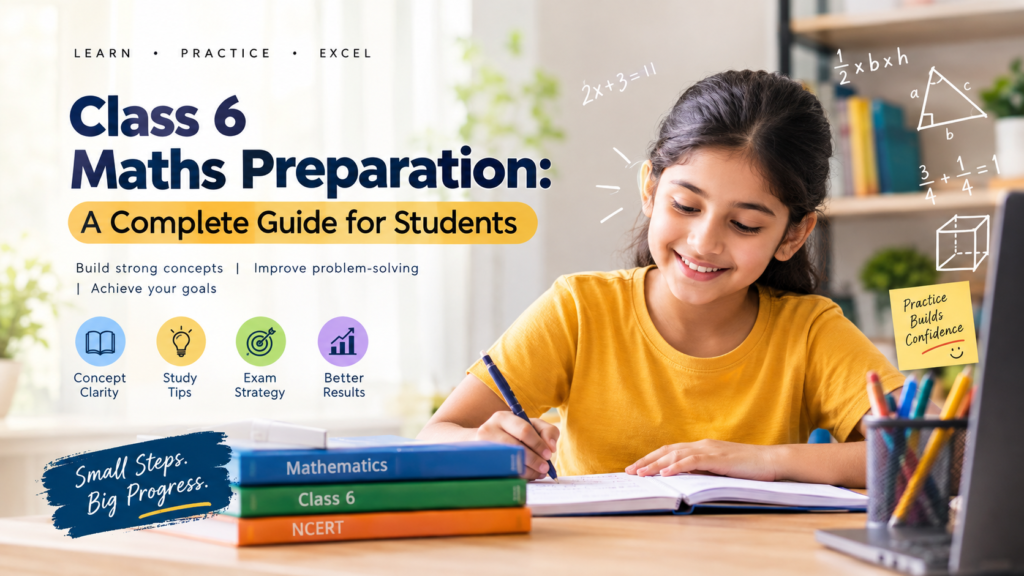
Table of Contents
Moving from Class 5 to Class 6 is an important academic transition. Students are introduced to new concepts, more detailed problem-solving, and a more structured approach to learning. For many students, Class 6 Maths preparation can feel challenging at first because the subject requires more than simply remembering formulas or completing exercises.
The right study routine can make Maths easier and more enjoyable. Students should focus on understanding concepts, practising regularly, solving different types of questions, and learning from their mistakes.
For the 2026–27 academic session, the NCERT Class 6 Mathematics curriculum uses the Ganita Prakash textbook and includes areas such as patterns, lines and angles, numbers, data handling, fractions, perimeter and area, constructions, symmetry, and integers.
This guide explains practical Class 6 study tips, Class 6 CBSE preparation strategies, and useful Class 6 Maths tips to help students build a strong foundation.
Class 6 Study Tips
Good study habits are more important than studying for long hours. Class 6 students should develop a consistent routine that allows enough time for schoolwork, revision, practice, and relaxation.
Here are some useful Class 6 study tips:
1. Create a Simple Study Schedule
Make a daily timetable that divides study time between different subjects. Maths should be practised regularly rather than left for the day before a test.
For example, students can spend 30–45 minutes on Maths practice each day depending on their school schedule and workload.
2. Study in Short, Focused Sessions
Instead of studying continuously for several hours, divide study time into smaller sessions. A focused 30-minute Maths session can be more productive than a long session filled with distractions.
Keep the phone, television, and unnecessary distractions away during study time.
3. Understand Before Memorising
Maths becomes easier when students understand why a method works. Instead of memorising every step, try to understand the concept behind the solution.
If a student does not understand a topic, they should ask their teacher or tutor rather than repeatedly memorising the same solution.
4. Maintain a Maths Notebook
Keep a separate notebook for Maths practice. Write important concepts, examples, formulas, common mistakes, and questions that were difficult to solve.
Review this notebook regularly before tests and exams.
5. Revise Regularly
Do not wait until exams to revise the entire syllabus. Revise each chapter after completing it and return to difficult topics regularly.
Regular revision improves memory and helps students identify gaps in their understanding.
6. Learn From Mistakes
Making mistakes is a normal part of learning Maths. Instead of simply checking the correct answer, students should find out where their method went wrong.
Maintaining a small “mistake list” can help students avoid repeating the same errors.
Class 6 CBSE Preparation
Effective Class 6 CBSE preparation begins with understanding the syllabus and building concepts from the beginning of the academic year.
CBSE’s competency-based learning framework for Classes 6–10 emphasizes mathematical learning outcomes and skills such as problem-solving and applying concepts rather than relying only on memorisation.
Students can follow these steps for better CBSE preparation.
1. Understand the Complete Syllabus
Before beginning exam preparation, students should know what topics they need to study. Create a checklist of chapters and mark them as:
Not started
Learning
Practised
Revised
This makes preparation easier to track.
2. Follow the NCERT Textbook
For CBSE students, the prescribed NCERT textbook should be the starting point for preparation.
Students should carefully read examples, understand the concepts, and complete the exercises instead of jumping immediately to difficult reference books.
3. Practise Different Types of Questions
Understanding one example is not enough. Students should solve different questions based on the same concept.
For example, after learning fractions, practise questions involving comparison, equivalent fractions, addition, subtraction, and real-life applications.
4. Revise Difficult Chapters More Often
Not every chapter will be equally difficult for every student. Identify weaker areas and give them additional practice.
A student who struggles with fractions, geometry, or integers should spend more time practising those concepts.
5. Use Tests to Check Progress
Short tests can help students understand whether they have actually learned a topic.
After completing a chapter, solve a small set of questions without looking at the textbook. Check the answers afterward and review every mistake.
6. Focus on Conceptual Understanding
Class 6 is an important stage for developing mathematical thinking. Students should focus on understanding numbers, patterns, geometry, measurement, data, fractions, and other concepts rather than simply memorising procedures.
This approach can make later Maths topics easier to understand.
How to Study in Class 6
Students often ask how to study in Class 6 without feeling overwhelmed. The answer is to build a simple and consistent routine.
A practical daily routine can look like this:
Step 1: Review schoolwork
Spend 10–15 minutes reviewing what was taught in school that day.
Step 2: Complete homework
Finish homework carefully rather than rushing through it.
Step 3: Practise Maths
Spend dedicated time solving Maths questions. Focus particularly on topics that were difficult during the school lesson.
Step 4: Revise one older topic
Spend a few minutes revising a previously completed chapter or concept.
Step 5: Clear doubts
Write down questions or concepts that are unclear and ask the teacher or tutor for help.
Step 6: Prepare for the next day
Quickly review the topics that will be taught next so that the student enters class with some background knowledge.
Avoid Last-Minute Studying
One of the biggest mistakes students make is waiting until exams are close before starting preparation.
A better approach is to study consistently throughout the year. Even 30 minutes of focused Maths practice several days a week can make a difference when compared with trying to complete a large amount of work just before an examination.
Take Breaks
Students also need adequate breaks. Studying continuously without rest can reduce concentration.
A balanced routine should include study time, physical activity, hobbies, family time, and sufficient sleep.
Class 6 Maths Tips
Maths requires regular practice, but practising randomly is not always effective. Students should follow a structured approach.
Here are some useful Class 6 Maths tips:
1. Read the Question Carefully
Many mistakes happen because students do not understand what a question is asking.
Before solving, identify:
What information is given?
What needs to be found?
Which mathematical operation or concept is required?
Are there any important units or conditions?
2. Show Your Steps
Do not solve every problem mentally. Writing the steps makes it easier to identify mistakes and helps students develop a logical approach to problem-solving.
3. Practise Mental Maths
Mental calculations can improve speed and number sense. Practise basic addition, subtraction, multiplication, division, fractions, and number relationships regularly.
4. Draw Diagrams for Geometry
When solving geometry questions, diagrams can make the problem easier to understand.
Students should practise identifying lines, angles, shapes, symmetry, and measurements visually.
5. Use Real-Life Examples
Connecting Maths with everyday situations can make abstract concepts easier to understand.
For example:
Fractions can be related to sharing food.
Measurement can be connected with cooking or shopping.
Money can be used to practise calculations.
Data can be represented using simple charts.
Geometry can be explored through objects around the home.
6. Practise Word Problems
Word problems require students to understand information, choose the correct method, and calculate the answer.
Read the problem carefully, underline important information, identify what needs to be found, and then solve it step by step.
7. Check Your Answer
After solving a problem, spend a few seconds checking the calculation.
Ask yourself:
Did I use the correct operation?
Did I copy the numbers correctly?
Did I include the correct unit?
Does the answer make sense?
This simple habit can reduce avoidable Maths mistakes.
A Simple Weekly Class 6 Maths Preparation Plan
A weekly plan can help students stay consistent without feeling pressured.
| Day | Maths Activity |
|---|---|
| Monday | Learn and practise a new concept |
| Tuesday | Solve textbook exercises |
| Wednesday | Practise difficult questions |
| Thursday | Revise an older topic |
| Friday | Solve word problems |
| Saturday | Take a short Maths test |
| Sunday | Review mistakes and revise |
Students can adjust this schedule according to their school timetable and individual learning needs.
How Parents Can Support Class 6 Maths Preparation
Parents do not need to teach every Maths concept themselves. Their most important role is to create an environment where children can study consistently and ask for help when they need it.
Parents can:
Encourage regular Maths practice.
Ask children to explain what they learned.
Avoid putting unnecessary pressure on marks.
Celebrate improvement and effort.
Help children maintain a study routine.
Encourage them to ask questions when they are confused.
Monitor homework and revision without doing the work for them.
If a child consistently struggles with basic concepts, makes the same mistakes repeatedly, or feels anxious about Maths, additional academic support from a qualified teacher or tutor can be helpful.
Common Mistakes Students Should Avoid in Class 6 Maths
During Class 6 Maths preparation, students should watch out for common habits that can affect their performance.
Skipping basic concepts: Advanced questions become difficult when foundational concepts are unclear.
Only reading solutions: Maths improves through solving, not just reading.
Ignoring mistakes: Checking the correct answer without understanding the error does not improve future performance.
Studying only before exams: Regular practice is much more effective.
Rushing calculations: Speed without accuracy can lead to unnecessary mistakes.
Avoiding difficult questions: Challenging questions are opportunities to improve problem-solving skills.
Final Thoughts
Successful Class 6 Maths preparation is not about studying for hours every day. It is about developing the right habits early.
Students should understand concepts, practise regularly, revise consistently, solve different types of questions, and learn from their mistakes. With a structured routine and the right support, Class 6 Maths can become much more manageable and enjoyable.
Most importantly, students should remember that struggling with a Maths topic does not mean they are “bad at Maths.” With patience, practice, and proper guidance, mathematical skills can improve over time.
Tutor Today focuses on personalized learning and academic support to help students strengthen their concepts, improve confidence, and develop better learning habits.
#1 Tuition Center for Cbse & Icse Education
READ MORE :
- Does my child need tuition
- AI tools for homework
- why is my child weak in Math
- online English speaking course
- Benefits Of Offline tuition
- How to Find you find the best online tutor
- Tutoring Services Near Me
- offline coaching classes in Noida
- Best Tutor Near Me
- tuition class near me
- online and offline tuition
- Best Offline Tuition Classes in Delhi
- Tuition Classes in Noida Sector 26
- Best CBSE Tuition in Noida
LinkedIn
WhatsApp
Facebook
Pinterest
X
Tumblr
Tutor Today Blogs