
How to Stop Making Silly Mistakes in Maths Exams
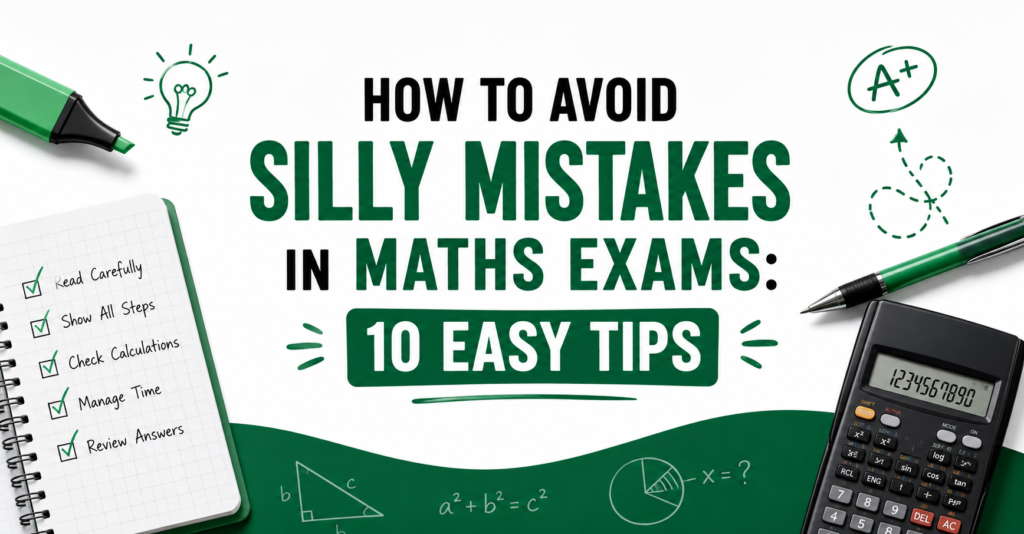
Table of Contents
Maths is a subject where even a small mistake can turn a correct approach into a wrong answer. You may understand the concept, remember the formula, and know exactly how to solve a problem—but a missed minus sign, incorrect calculation, or misread question can still cost you marks.
The good news is that most Maths exam mistakes can be reduced with the right practice and exam strategy.
If you often think, “I knew the answer, but I made a silly mistake,” this guide will help you understand how to avoid silly mistakes in maths and improve your accuracy and marks.
Why Do Students Make Silly Mistakes in Maths Exams?
Silly mistakes usually don’t happen because a student doesn’t understand Maths. They often happen because of carelessness, pressure, or rushing.
Some common reasons include:
- Reading the question too quickly
- Copying numbers incorrectly
- Making calculation errors
- Forgetting negative signs
- Using the wrong formula
- Skipping important steps
- Confusing units
- Not checking the final answer
- Spending too much time on one question
During an exam, students may also become nervous when they see a difficult question. This can make them rush through questions they actually know how to solve.
The goal is not simply to solve questions faster. The goal is to solve them accurately and efficiently.
How to Avoid Silly Mistakes in Maths Exams
Learning how to avoid silly mistakes in maths requires a simple process. Instead of trying to be “more careful” without a strategy, follow these steps every time you practise and take an exam.
Step 1: Read the Question Carefully
Before starting any calculation, read the entire question.
Pay attention to words such as:
- Find
- Calculate
- Prove
- Difference
- Sum
- Area
- Perimeter
- Approximate
- Correct to
- Percentage
Many students start solving immediately after seeing the numbers. This can lead to answering the wrong thing.
Take a few seconds to understand exactly what the question is asking.
Step 2: Write Down the Given Information
Identify the information provided in the question before beginning the solution.
For example, if a question gives you the length, breadth, and asks for the area of a rectangle, write down the values first.
This small habit reduces the chance of using the wrong number or forgetting an important piece of information.
Step 3: Choose the Correct Formula or Method
Formula mistakes are among the most common Maths exam mistakes.
Before substituting values, ask yourself:
“Is this the correct formula for this question?”
For example, don’t confuse the formulas for area and perimeter. Similarly, check whether a question requires addition, subtraction, multiplication, division, a percentage calculation, or an algebraic method.
Understanding concepts instead of memorising formulas blindly can make this step much easier.
Step 4: Solve Step by Step
Avoid doing too many calculations mentally.
Write important steps clearly, especially when solving lengthy algebraic expressions, geometry problems, fractions, or word problems.
For example:
Instead of jumping directly from the question to the final answer, show the formula, substitution, calculation, and final result.
Writing steps makes it easier to identify where an error occurred and can also help you receive method marks where applicable.
Step 5: Check Signs, Units, and Decimal Points
A single symbol can change an answer completely.
Before moving to the next question, quickly check:
- Plus and minus signs
- Multiplication and division
- Decimal points
- Fractions
- Brackets
- Units
- Negative numbers
For example, if the question uses metres but your answer is written in centimetres, make sure the required conversion has been done correctly.
These simple checks are some of the most effective Maths accuracy tips for exams.
Step 6: Recheck Your Answer
Don’t assume your answer is correct just because your calculation looks complete.
Ask yourself:
Does this answer make sense?
Try checking the calculation using another method when possible. For example, you can estimate the answer first and compare it with your final result.
If your estimate is around 50 but your calculated answer is 5,000, you probably need to check your working.
Common Maths Exam Mistakes Students Should Avoid
Understanding your common mistakes is one of the easiest ways to improve your performance.
Here are some mistakes students should watch for:
1. Misreading the Question
A student may calculate the area when the question asks for the perimeter or find the total when the question asks for the difference.
2. Copying Numbers Incorrectly
A single incorrectly copied number can make the entire solution wrong.
3. Using the Wrong Formula
Knowing formulas is important, but knowing when to use them is equally important.
4. Calculation Errors
Basic addition, subtraction, multiplication, and division errors can happen when students rush.
5. Forgetting Units
Always check whether the final answer requires cm, m, km, cm², m², or another unit.
6. Skipping Steps
Trying to save time by doing everything mentally can actually increase mistakes.
7. Not Checking the Final Answer
Even if you have finished the question, spend a few seconds checking your solution.
Maths Accuracy Tips to Improve Your Score
Improving Maths accuracy is not about becoming perfect overnight. It comes from developing consistent habits.
Here are some practical Maths accuracy tips:
Write neatly: Clear working makes it easier to spot mistakes.
Keep calculations organised: Avoid mixing different calculations on the same line.
Estimate first: A rough estimate can help you identify unreasonable answers.
Show your working: Don’t depend entirely on mental calculations.
Underline important information: This can help you focus on what the question actually asks.
Circle or box the final answer: This makes it easier to check whether you answered every question.
Slow down on easy questions: Students often make careless mistakes on questions they believe are too simple.
How to Improve Maths Marks Through Better Accuracy
If you want to know how to improve Maths marks, don’t focus only on solving more difficult questions. Reducing avoidable errors can also make a noticeable difference.
Practise With a Timer
Timed practice helps you become comfortable solving questions under exam conditions.
Start by focusing on accuracy. Once you become confident, gradually increase your speed.
Maintain a Mistake Notebook
Create a small notebook specifically for your errors.
Write down:
- The question
- Your incorrect answer
- The correct answer
- Why you made the mistake
- How you can avoid it next time
After a few weeks, you’ll begin to notice patterns in your mistakes.
Analyse Every Wrong Answer
Don’t simply look at the correct solution and move on.
Ask yourself:
“Where exactly did I go wrong?”
Was it a concept problem, calculation error, formula mistake, or careless reading?
Knowing the reason behind a mistake is more valuable than simply knowing the correct answer.
Practise Similar Questions
If you repeatedly make mistakes in fractions, algebra, percentages, or geometry, practise several questions from that specific topic.
Targeted practice is often more effective than randomly solving hundreds of questions.
A 5-Minute Final Checking Strategy for Maths Exams
If you have extra time at the end of your exam, don’t use it to sit and wait. Use it strategically.
Follow this quick checklist:
Minute 1: Check whether every question has been attempted.
Minute 2: Recheck calculations, especially lengthy ones.
Minute 3: Check formulas, signs, brackets, and decimal points.
Minute 4: Check units and conversions.
Minute 5: Review questions where you felt unsure.
This simple routine can help catch several avoidable errors before you submit your paper.
Final Checklist to Avoid Silly Mistakes in Maths
Before submitting your Maths paper, ask yourself:
- Did I read every question carefully?
- Did I use the correct formula?
- Did I copy all numbers correctly?
- Did I check my calculations?
- Did I check plus and minus signs?
- Did I include the correct units?
- Did I answer exactly what was asked?
- Did I recheck the questions I found difficult?
Remember, accuracy is a skill that can be developed.
If you regularly make silly mistakes in Maths, don’t simply tell yourself to “be careful.” Identify the type of mistakes you make, practise them deliberately, and develop a habit of checking your work.
With consistent practice and the right exam strategy, you can reduce Maths exam mistakes, improve accuracy, and turn more of your correct solutions into marks.
Tips for Maths Exams
READ MORE :
- AI tools for homework
- why is my child weak in Math
- online English speaking course
- Benefits Of Offline tuition
- How to Find you find the best online tutor
- Tutoring Services Near Me
- offline coaching classes in Noida
- Best Tutor Near Me
- tuition class near me
- online and offline tuition
- Best Offline Tuition Classes in Delhi
- Tuition Classes in Noida Sector 26
- Best CBSE Tuition in Noida
Frequently Asked Questions
1. How can I avoid silly mistakes in Maths exams?
Read each question carefully, write down the given information, use the correct formula, solve step by step, and leave a few minutes to check your answers.
2. Why do I make careless mistakes in Maths?
Careless mistakes can happen because of rushing, exam pressure, poor calculation habits, misreading questions, or skipping steps. Identifying your most common error can help you prevent it.
3. How can I improve my Maths accuracy?
Practise regularly, solve questions step by step, maintain a mistake notebook, check your calculations, and practise under timed exam conditions.
4. How can I improve my Maths marks without studying more?
Improving accuracy can help you gain marks that you may already be losing through avoidable errors. Focus on reducing calculation mistakes, checking formulas, reading questions carefully, and reviewing your answers.
5. Should I recheck my Maths answers in an exam?
Yes. If you finish early, use the remaining time to check calculations, signs, formulas, units, and unanswered questions. A few minutes of careful checking can help catch avoidable mistakes.
LinkedIn
WhatsApp
Facebook
Pinterest
X
Tumblr
Tutor Today Blogs